
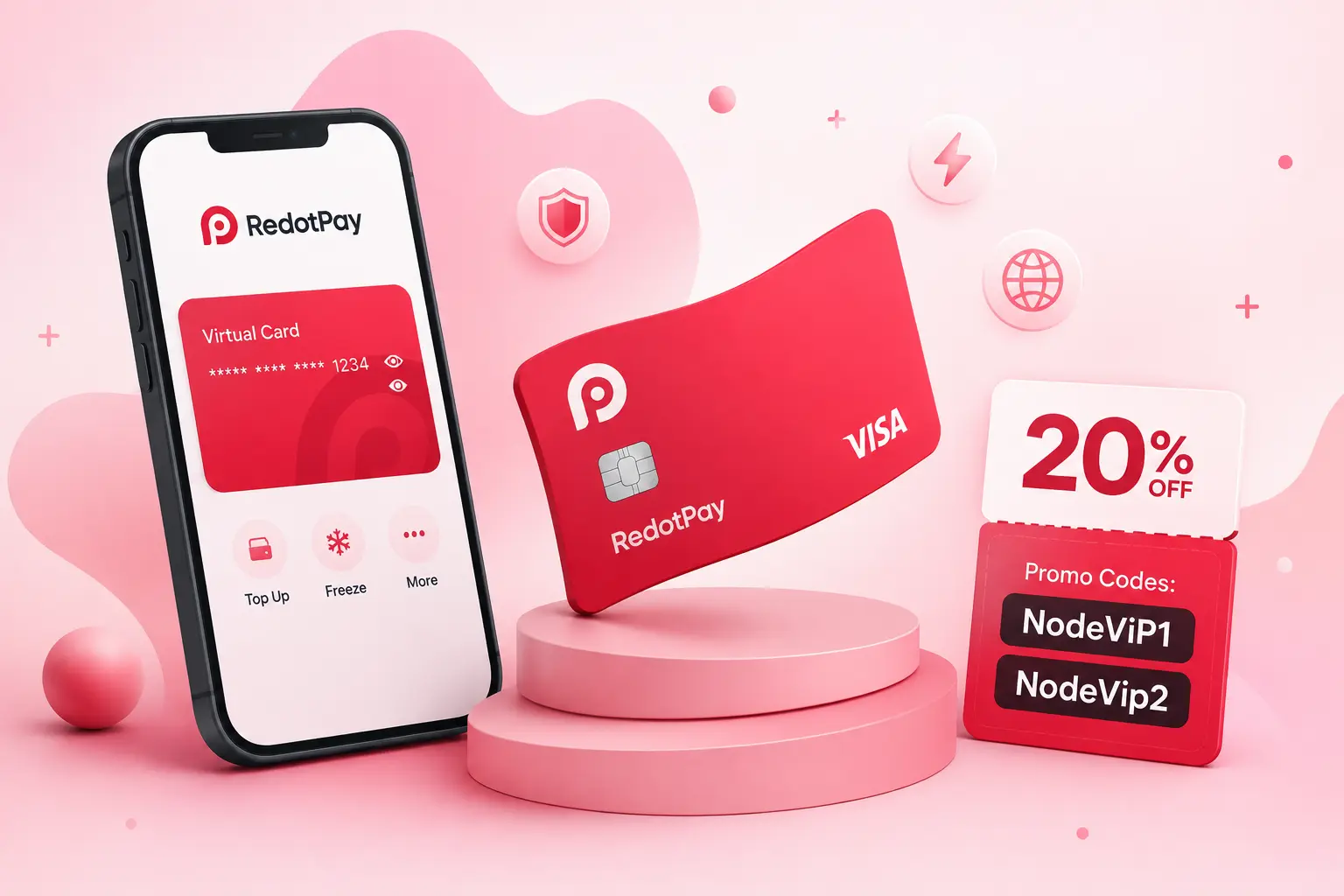
RedotPay Virtual & Physical Card Promo Code: 20% Off (2026)
RedotPay virtual card $10 → $8 and physical card $100 → $80 with our 20% promo codes. Real fee breakdown, ATM limits and which card is worth it.
RedotPay Virtual card Promo Code
Online payments and mobile wallet. Issued in minutes.
$10 $8 one time · save $2
NodeViP1
- Online payments
- Apple Pay / Google Pay
- In-store chip & PIN
- ATM withdrawals
Enter at the card purchase step, not at registration.
RedotPay Physical card Promo Code
Everything the virtual card does, plus cash. Ships to you.
$100 $80 one time · save $20
NodeVip2
- Online payments
- Apple Pay / Google Pay
- In-store chip & PIN
- ATM withdrawals
Enter at the card purchase step, not at registration.
The short version
- RedotPay is a Hong Kong–based crypto payment app paired with a prepaid Visa card. You fund a balance with crypto, and the card converts it to fiat the moment you pay.
- The virtual card costs $10 one time. Enter NodeViP1 at the purchase step and it drops to roughly $8.
- The physical card costs $100 one time. Enter NodeVip2 and it drops to roughly $80.
- There is no monthly or annual fee. Your real ongoing cost is the spread on each transaction: about 1% crypto conversion plus 1.2% FX when you spend outside your card currency.
- Only the physical card does ATMs and in-store chip payments. If you only shop online, the virtual card does the same job for a tenth of the price.
If you hold USDT and you have ever tried to pay for a Netflix subscription, a plane ticket or a grocery run with it, you know the gap. The money is right there on-chain, and none of it is spendable without a detour through an exchange, a bank transfer and a two-day wait.
Crypto cards exist to close that gap, and RedotPay has become one of the more widely used ones, partly because its country list is longer than most competitors, and partly because it does not lock its best features behind a monthly subscription. This guide walks through both card types, the fees nobody puts on the landing page, and how to apply the two 20% codes so you are not paying full price for a piece of plastic.
What RedotPay actually is
RedotPay was founded in 2023 and is headquartered in Hong Kong. The core product is a prepaid Visa card tied to a wallet inside the RedotPay app. You deposit crypto, the balance sits in the app, and when you tap or type in the card number, RedotPay converts just enough of that balance into fiat to settle the purchase. The merchant sees an ordinary Visa transaction and never knows crypto was involved.
Two details matter more than anything else on the marketing page:
It is prepaid, not credit. You cannot spend money you have not already deposited. If the balance runs dry mid-transaction, the payment declines like any other prepaid card. RedotPay has since added a separate crypto-backed credit line as its own product, but the card itself draws from your prepaid balance.
It is custodial. Your funds sit on RedotPay's platform, held through its custody partner, and you do not hold the private keys to that card balance. This is the standard trade-off across nearly every crypto card that works at ordinary merchants, the ability to settle in fiat at a POS terminal requires an issuer standing behind it. It is not a flaw so much as a design constraint, but you should know it before you park a large balance there.
Treat the card balance as spending money, not savings.
Beyond the card, the app has grown into a broader wallet over 2026, a multi-currency wallet, peer-to-peer marketplace, scan-to-pay, mobile top-ups and yield products. Most people still come for the card.
Virtual vs physical: which one do you actually need
This is the decision the codes hang on, so it is worth getting right before you pay for anything. The two cards run on the same rails and charge identical spending fees. What separates them is a ten-times difference in issuance price and one meaningful capability.
| Feature | Virtual card | Physical card |
|---|---|---|
| One-time issuance fee | $10 → $8 with the code | $100 → $80 with the code |
| Monthly / annual fee | None | None |
| Online payments | Yes | Yes |
| Apple Pay / Google Pay | Yes (see the wallet note below) | Yes (see the wallet note below) |
| In-store chip & PIN | No | Yes |
| ATM cash withdrawals | No | Yes |
| Time to activate | Minutes after KYC and funding | Days to weeks — it ships to you |
| Crypto conversion fee | ~1% | ~1% |
| FX markup on non-card currency | ~1.2% | ~1.2% |
Choose the virtual card if…
You mostly pay online, subscriptions, ads accounts, SaaS tools, travel bookings, e-commerce, and you carry a phone that supports a mobile wallet. At $8 with the code, it is close to a no-risk trial of the whole platform. Fund it with $20, buy something small, and see whether the app and the conversion rate behave the way you want before committing further.
Choose the physical card if…
You need cash. That is genuinely the main reason. The physical card is the only route to ATM withdrawals and to in-store terminals that will not take a phone tap. If you live somewhere with patchy contactless acceptance, or you need to convert stablecoins into local banknotes without going through a peer-to-peer trade, the $80 is buying you a cash-out channel rather than a payment method.
An honest recommendation: if you are not sure, start with the virtual card at $8. You can order the physical card later from the same verified account. Doing it in that order costs you $8 extra in total. Doing it in the wrong order can cost you $80 for a card that sits in a drawer.
The codes, and exactly what they save you
Both codes do the same thing: 20% off the one-time card issuance fee, applied at the moment you buy the card. They do not change any of the ongoing spending fees, and they are not stackable with each other, each code is tied to its own card type.
| Code | Applies to | Standard | With code | You keep |
|---|---|---|---|---|
| NodeViP1 | Virtual card | $10 | $8 | $2 |
| NodeVip2 | Physical card | $100 | $80 | $20 |
| Both | One of each card | $110 | $88 | $22 |
Two things to keep in mind. First, the issuance fee is charged in USDT and is non-refundable once the card is issued, so the code is only useful if you were going to buy the card anyway. Second, codes on crypto platforms rotate. If a code stops applying at the purchase screen, it has been retired, not broken; check for a current one rather than retrying it.
Separately from the discount, new accounts that register through a referral link are typically eligible for a $5 USDT welcome bonus. It usually expires around 30 days after issue and is spendable at merchants rather than applied against the card fee, so plan a small purchase before it lapses.
How to apply the code, step by step
The single most common complaint about crypto card codes is people entering them in the wrong field. There are usually two separate boxes in the signup flow, a referral or invite code at registration, and a promo code at the card purchase step. The 20% discount lives in the second one.
- Register and verify
Download the RedotPay app, sign up with your phone or email, and complete KYC. You will need a government ID and a liveness selfie. Verification is usually same-day but can take longer if your document scans poorly, use good light and a flat surface.
- Fund the account first
Deposit at least enough to cover the card fee plus a little spending money. Crypto deposits are the cheapest route, typically free. Confirm the network before you send, sending USDT on a network the app does not credit is how people lose money here, and no code helps with that.
- Go to the card section and choose your type
Virtual or physical. Do not tap through to payment yet.
- Find the promo code field on the purchase screen
It is usually a small “Promo code”, “Discount code” or “Have a code?” link just above the total. Tap it to expand the input.
- Enter the code exactly as written
NodeViP1 for the virtual card, NodeVip2 for the physical card. Copy and paste rather than typing, the capitalisation pattern is easy to get wrong by hand, and some fields treat codes as case-sensitive.
- Confirm the total changed before you pay
This is the step to slow down on. The displayed total should read about $8 or $80, not $10 or $100. If it has not moved, the code has not applied, back out and re-enter it rather than paying full price and asking support to adjust it afterwards.
- Complete the purchase
The fee is deducted from your app balance. A virtual card is issued almost immediately. A physical card enters shipping, and delivery times vary a lot by country.
The full fee picture
The issuance fee is the number everyone compares. It is also the least important one, because you pay it once. What actually determines whether RedotPay is cheap for you is the stack of small percentages on every transaction.
| Fee | Amount | When it hits |
|---|---|---|
| Virtual card issuance | $10 (or $8 with the code) | Once, non-refundable |
| Physical card issuance | $100 (or $80 with the code) | Once, non-refundable |
| Monthly / annual fee | $0 | Never |
| Crypto top-up | Free | On-chain deposits |
| Binance Pay top-up | ~1% | Per top-up |
| Debit/credit card top-up | ~3% | Per top-up, avoid this route |
| Crypto conversion | ~1% | Every purchase |
| FX markup | ~1.2% | Any spend not in your card's currency |
| ATM withdrawal | ~2%–4%+ | Physical card only; varies by tier, volume and region |
| Select merchant categories | ~1.5%, min ~$0.50 | A published list including some ad platforms and games, after a small monthly free allowance |
The ATM figure is the one where published sources disagree most, reported rates range from roughly 2% up to above 4% depending on your tier, monthly withdrawal volume and country. Check the live number in the app before your first withdrawal, and remember the ATM operator's own surcharge sits on top of whatever RedotPay charges.
What that means in practice
Say you spend $1,000 a month, all of it in a currency different from your card's base currency. The conversion fee takes roughly $10 and the FX markup roughly $12, so you are paying around $22 a month, or about 2.2%. Over a year that is roughly $264, which dwarfs the $8 or $80 you paid for the card.
Now say you spend the same $1,000 but mostly at USD-denominated merchants, where the FX markup does not apply. You are closer to $10 a month, around 1%. Same card, less than half the cost.
The lesson is simple and it is worth more than any code: the currency you spend in matters more than the card you choose. If most of your spending is with international online merchants that bill in USD, RedotPay is inexpensive. If every purchase is a local-currency conversion, budget for the full 2.2%.
One more thing worth stating plainly: RedotPay's base card does not offer cashback. Several competing crypto cards do, in the 1–3% range. If you are a heavy spender chasing rewards, the honest answer is that RedotPay is not built for you, it is built for access and availability, not for earning.
Supported crypto and where the card works
On the funding side, RedotPay supports the assets you would expect a spending card to support. Stablecoins are the practical choice, USDT and USDC because they remove volatility between the moment you fund and the moment you spend. Major coins including BTC, ETH, BNB, SOL, XRP, SUI and TRX are also supported for the card balance, alongside additional assets through the multi-currency wallet.
Spending with volatile assets works, but think about what it means. Paying for lunch with BTC means locking in a price at the till, and it can create a taxable disposal event in many jurisdictions. Fund with stablecoins unless you have a specific reason not to.
On availability, RedotPay is one of the broader crypto cards on the market, commonly cited as working across 100 to 130+ countries, with the card itself accepted anywhere Visa is. But two caveats apply. First, availability varies by jurisdiction and changes; the country list for opening an account is not identical to the list where the app works at all. Second, physical card delivery is unavailable in several countries where the app itself is accessible.
Check delivery to your address before you pay $80 for shipping you cannot receive.
The mobile wallet situation
This deserves its own note because it caught a lot of users out. Cards issued after 22 August 2025 initially could not be linked directly to Apple Pay. RedotPay began rolling out a free card upgrade on 15 January 2026 that restores Apple Pay compatibility. If you hold a card issued in that window and it will not add to your wallet, request the upgrade through in-app support rather than buying a new card. If you are ordering fresh today, confirm wallet support in the app before purchase, for a virtual card, mobile wallet compatibility is most of the value.
Where it earns its keep, and where it does not
Strong points
- Genuinely wide country coverage, including markets most fintech cards ignore
- No monthly or annual fee and no paid tier required for the core card
- Free crypto top-ups
- Virtual card is cheap enough to test the platform without commitment
- Instant conversion at the point of sale, no pre-loading a fiat balance
- Regulated footing: Hong Kong licensing plus US MSB registration, issuing on Visa rails
- Physical card unlocks ATM cash in places where cashing out is otherwise painful
Real drawbacks
- No cashback on the base card, while several rivals pay 1–3%
- Roughly 2.2% all-in on non-USD spending, not cheap for daily local use
- Custodial: you do not control the keys to your card balance
- $100 for a physical card is steep next to the $10 virtual card
- Card fees are non-refundable even if the card underperforms for you
- Mixed public review sentiment, with support response times a recurring complaint
- 3% top-up fee if you fund with a bank card instead of crypto
Who this is genuinely a good fit for
Freelancers and remote workers paid in stablecoins. If your income lands as USDT, the alternative is an exchange withdrawal to a local bank, and in many countries that is slow, expensive or unavailable. The card converts the hop into a swipe.
People buying international online services. Ad platforms, cloud infrastructure, SaaS subscriptions and app stores usually bill in USD, which happens to be the case where RedotPay's fees are lowest.
Travellers holding crypto. Spending abroad from a stablecoin balance sidesteps a bank's own foreign transaction fee, though you trade it for RedotPay's 1.2%.
People in countries with thin fintech coverage. This is RedotPay's real advantage. It works in places where the popular neobank cards simply are not offered.
And who should skip it
If you want rewards, look at cards paying cashback instead. If self-custody is non-negotiable, look at self-custodial cards, hey exist, with narrower country coverage. If you only need a card for one purchase, the fee plus spread probably costs more than whatever workaround you were avoiding. And if you were only going to use it domestically in your local currency, run the 2.2% against your bank's own fees before you commit; sometimes the boring bank card wins.
RedotPay Virtual card
$10 $8 20% off
NodeViP1
RedotPay Physical card
$100 $80 20% off
NodeVip2
The verdict
RedotPay is not the cheapest crypto card, and it is definitely not the most rewarding one. What it is, reliably, is available, in more countries, with fewer hoops, and without a subscription attached. For a lot of people that availability is the entire value proposition, and the fee stack is simply the price of admission.
The sensible way in is the cheap one. Take the virtual card at $8 with NodeViP1, fund it with a small amount of USDT, and put through a couple of real transactions. Watch the conversion rate you actually receive, not the one advertised. If the platform behaves and you find yourself reaching for it, the physical card at $80 with NodeVip2 is there when you need ATM access.
Buy the $80 card first and you are betting $80 on a platform you have not tested. Buy the $8 card first and the worst case costs you the price of a coffee.
Both codes, one place
Enter these at the card purchase step in the RedotPay app, not at registration, and confirm the total drops before you pay.
Disclosure: this article contains promotional codes. The publisher may earn a commission if you sign up through them, at no extra cost to you. This does not change the fees you pay or the assessment above.
Accuracy: fees, country availability, wallet support and promo codes change frequently and vary by region. Every figure here was checked in August 2026 and is presented as a guide, not a quote. Always confirm the live numbers in the RedotPay app before you pay.
Not financial advice. Crypto assets are volatile and custodial platforms carry counterparty risk. Only deposit what you can afford to lose, and consider your own tax obligations before spending appreciated crypto.
Frequently asked questions
Do the promo codes NodeViP1 and NodeVip2 still work?
Can I use both codes?
Is the card fee refundable if I change my mind?
Do I have to complete KYC?
Can the virtual card withdraw cash from an ATM?
Does it work with Apple Pay and Google Pay?
Are my funds safe on the platform?
Keep reading
DPT Pay Card Review: Fees, Limits & Promo Code
DPT Pay is a stablecoin Visa card from DPT (HK) Limited that lets you spend USDC and USDT …
2026-08-08
How to Get Early Access to the Peanut App and Card
Get early access to the Peanut app and card. Invite code `zeshan` opens the invite-only ap…
2026-08-01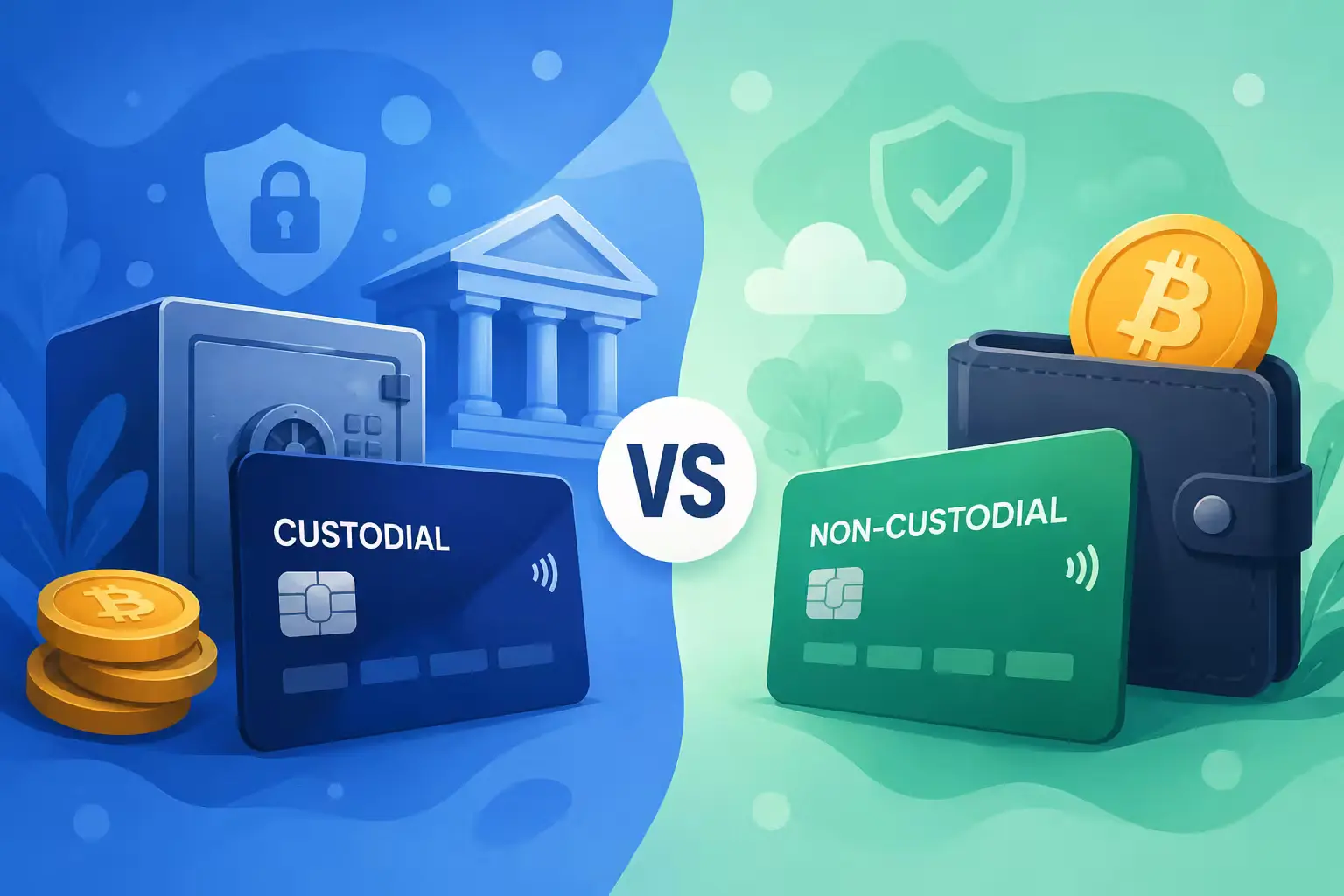
Custodial vs non-custodial crypto cards: what actually changes
The single biggest choice when picking a crypto card is who holds your money. Here is what…
2026-07-12