
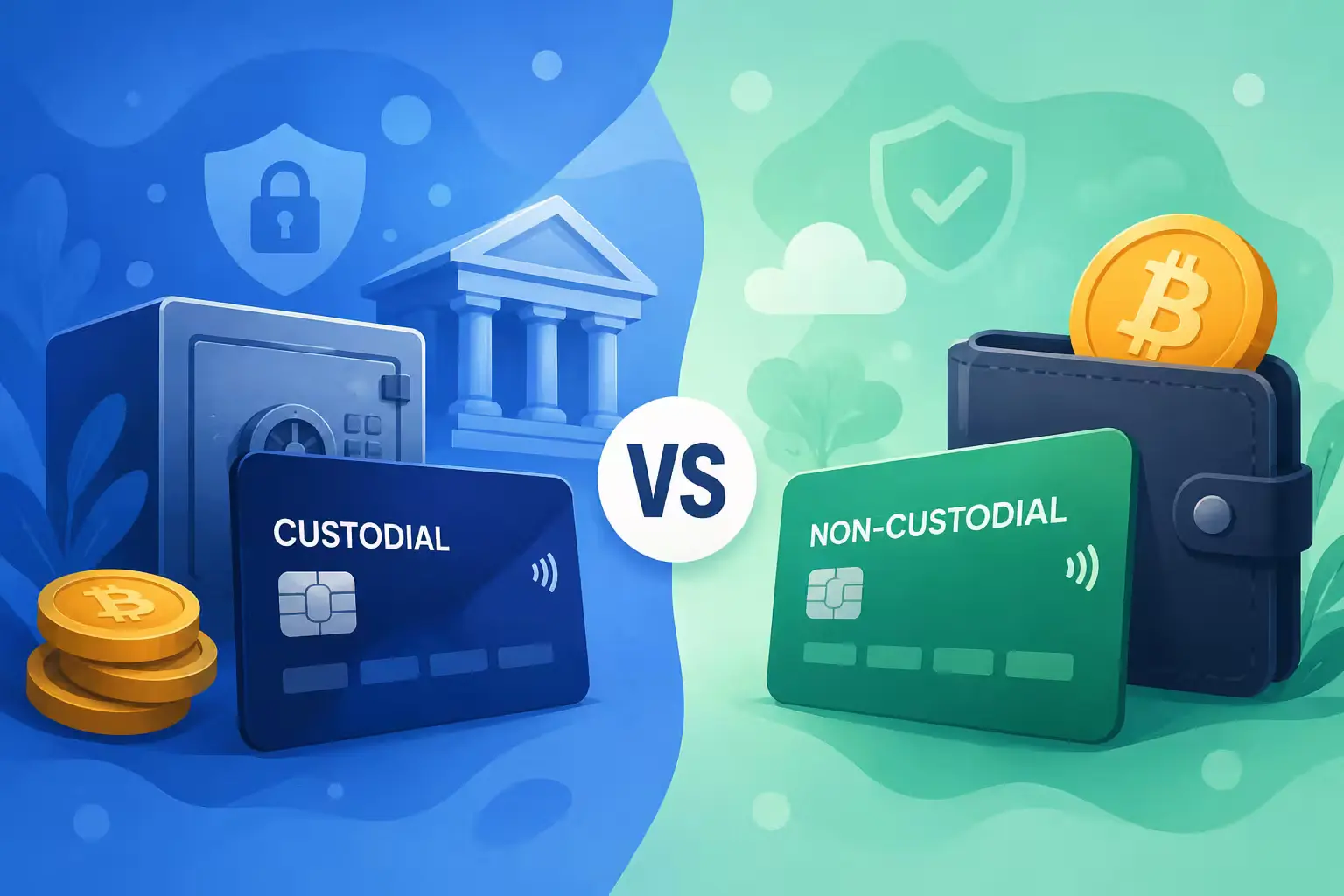
Custodial vs non-custodial crypto cards: what actually changes
The single biggest choice when picking a crypto card is who holds your money. Here is what custodial and non-custodial really mean for your funds, fees, and risk.
Two crypto cards can look identical in your pocket. Same Visa or Mastercard logo, same tap-to-pay, same acceptance at millions of merchants worldwide. But underneath, one of them is quietly holding your money on your behalf, and the other never touches it until the exact second you buy a coffee. That single difference, who has custody of the funds, cascades into everything that matters: what happens if the company goes bankrupt, whether you had to hand over your ID, how you recover access if something breaks, and even your tax paperwork.
If you've spent any time in crypto since 2022, you already know why this stopped being an academic question. This guide breaks down what actually changes between the two models, based on how these products work in practice rather than how their marketing describes them.
Custodial vs non-custodial crypto cards
A custodial crypto card is issued by a company, usually a centralized exchange, that holds your crypto for you and converts it to fiat when you spend. A non-custodial (self-custodial) crypto card spends directly from a wallet that only you control, so the provider never takes possession of your funds.
First, what a crypto card actually does
It helps to clear up a common misconception before comparing the two models. A crypto card is not a magic pipe that sends Bitcoin to a merchant. Merchants still want dollars, euros, or pounds. So at the point of sale, the card system converts your selected crypto into local fiat, and the merchant receives ordinary money through the Visa or Mastercard network. To the shop, it's an unremarkable card transaction.
What varies is where your crypto lives right up until that conversion happens, and who performs the conversion. That's the custodial question in a nutshell.
It's also worth remembering a subtle point that trips people up: a crypto wallet doesn't literally "contain" your coins. Your funds live on the blockchain. What the wallet holds is the private key, the cryptographic secret that authorizes moving those funds. So when we ask "who has custody," we're really asking who controls the private key. That framing makes the rest of this much clearer.
How custodial crypto cards work
With a custodial card, you open an account with a provider, think of the major exchange-branded cards, and you deposit crypto into that account. The provider generates and stores the private keys. You get an app that shows balances, lets you pick which asset to spend from, and handles the fiat conversion behind the scenes when you pay.
The experience feels like online banking, and that's the point. You log in with a username, password, and a two-factor prompt. If you forget your password, there's a reset link. If a transaction goes wrong, there's a support team you can contact. Onboarding is familiar, and you don't have to learn anything about seed phrases or gas fees.
The trade-off is that the provider is in control. Because they hold customer assets, custodial providers are increasingly treated like financial institutions, which means near-universal KYC identity verification, transaction monitoring, and the possibility that your account can be frozen to comply with regulation. Your data is linked to your spending, and the provider can see your transaction history.
Typical custodial card characteristics:
- Issued and managed by a centralized platform that holds your keys
- KYC identity verification is mandatory
- Password/email account recovery exists
- Rewards paid in the provider's ecosystem, cashback rates on major cards range from around 2% up to 8% depending on how many of the provider's native tokens you stake
- Often includes ATM cash withdrawal support
- You are exposed to the provider's solvency
How non-custodial crypto cards work
A non-custodial card connects to a wallet you own. Your funds stay in that wallet, frequently a smart-contract wallet on a blockchain, until the moment you spend. Only then does the system pull the required amount, convert it, and settle with the merchant. The provider never holds your balance.
The clearest real-world example of the model is Gnosis Pay, which launched in 2023 and is built around a self-custodial Safe smart account. Your euro stablecoin sits in a contract you control on-chain, and you spend directly from it at Visa merchants. The company describes the key promise plainly: even if Gnosis Pay ceases operations tomorrow, you will retain full access to your funds, they belong exclusively to you.
Another approach, used by cards like Ether.fi Cash, adds a lending twist. The card uses a non-custodial architecture built on Gnosis Safe. Your assets remain in a smart contract you control, the protocol cannot move your funds without your authorization. Instead of just spending stablecoins directly, you can borrow against yield-bearing collateral so your crypto keeps earning while you spend against it, with the important caveat that borrowing introduces liquidation risk if your collateral drops in value.
Typical non-custodial card characteristics:
- Linked to a wallet whose keys only you hold
- Recovery is via your seed phrase, there is no "forgot password" safety net
- Funds stay in your wallet until the instant of purchase
- Rewards often paid in the ecosystem's token; some cards reach up to 5% cashback
- Support tends to be lighter and more community-driven
- No exposure to the provider's insolvency for your stored funds
One practical quirk worth knowing: self-custody can add operational friction. Gnosis Pay, for example, applies a short delay on certain on-chain wallet actions as a security measure, during which the card can't be used. These are the kinds of small trade-offs that come with holding your own keys.
What actually changes: the seven differences that matter
1. Counterparty risk (the big one)
This is the difference that everything else orbits around. With a custodial card, if the company holding your balance becomes insolvent, your spending balance can disappear with it. You become an unsecured creditor in a bankruptcy proceeding, not an owner of segregated funds.
This isn't hypothetical. The 2022 collapse of FTX misappropriated billions in customer funds, froze withdrawals, and left users with no recourse. In the Celsius bankruptcy, a US bankruptcy court ruled that customer deposits into Celsius Earn Accounts became the property of the debtors' estate, not the depositors. The industry phrase "not your keys, not your coins", evolved from a philosophical stance into a compliance requirement almost overnight.
Non-custodial cards structurally eliminate this exposure for your stored funds. Because no third party ever holds the keys, non-custodial wallets keep funds entirely in user control, insulating them from provider insolvency. If the card company vanishes, the card stops working, but your money is still sitting in your wallet, and you can move to another provider.
It's no coincidence that self-custodial cards have gained traction since 2022. On several 2026 "best crypto card" lists, self-custody has become the default rather than the exception, with custodial exchange cards increasingly the minority in the top tier.
2. Who holds the keys (and what that means for control)
Custodial: the provider holds your private keys and can, in principle, restrict, freeze, or block your account to satisfy legal and regulatory obligations. You're trusting their security practices and their integrity.
Non-custodial: you hold the keys. No one can freeze your wallet. That's genuine financial autonomy, and also genuine responsibility, because there's no one to appeal to if you make a mistake.
3. Identity and privacy
Custodial cards almost always require full KYC, and because the provider processes your conversions, they can see your transaction records. Your spending is tied to your identity.
Non-custodial cards vary. Some pure self-custody setups require only a wallet connection and don't give the provider access to your transaction history. That said, don't overstate the privacy: blockchain activity can still be traceable, and any card touching the Visa/Mastercard networks in regulated markets will involve some compliance. Many self-custodial card programs (as opposed to raw wallets) still require KYC because a regulated entity issues the physical card. Read the specific product's terms rather than assuming.
4. Recovery when things go wrong
This cuts both ways and is genuinely a matter of temperament.
Custodial gives you a safety net. Forgot your password? Reset it. Locked out? Contact support. For many people, that's worth a lot.
Non-custodial gives you a seed phrase and full responsibility. Lose it, and the funds may be gone permanently, with no one able to help. Gnosis Pay is candid that self-custodial funds aren't covered by government deposit insurance the way a bank account might be. As one industry explainer puts it, non-custodial support focuses on education because support cannot recover lost keys.
5. Fees and rewards
There's no universal winner here, so compare effective rates after all fees rather than headline cashback numbers.
Custodial cards frequently advertise high cashback ceilings, but the top tiers often require staking large amounts of the provider's native token or paying for a membership. Watch for conversion fees too, some custodial cards charge a meaningful percentage on non-stablecoin spending, which can quietly cost hundreds a year.
Non-custodial cards can be strikingly cheap. Gnosis Pay, for instance, advertises 0% fees on transactions including FX and conversion (subsidized by the protocol), with cashback paid in its native token, though its cashback ceiling is lower and reaching the top tiers means holding a volatile token. Ether.fi Cash pays cashback in wrapped ETH and charges no conversion fee. The right answer depends entirely on your spending pattern and which reward token you actually want to hold.
6. Taxes and reporting
An important and frequently overlooked point: spending crypto is often a taxable event. When your card converts crypto to fiat at checkout, that conversion can trigger capital gains tax on the difference between what you paid for the crypto and its value at the moment of the sale. This is true regardless of custody model.
Where custody matters is recordkeeping. Custodial providers typically generate statements and reports. Self-custodial activity generates no statements, you're responsible for tracking your own cost basis and taxable events. And exchange closures have shown that relying on a custodian for your permanent tax records is fragile; defunct platforms have left users scrambling to reconstruct history from blockchain explorers.
Spending stablecoins rather than volatile assets is one common way people reduce taxable friction, since a stablecoin's value barely moves between acquisition and spending. None of this is tax advice, rules vary by country and your situation, so consult a qualified professional.
7. Availability and complexity
Custodial cards from large exchanges tend to be available in more regions and are simpler to start using. Non-custodial cards are often geographically limited, Gnosis Pay, for example, is currently focused on Europe and not available to US users, and they assume you're comfortable with wallets, stablecoins, and on-chain mechanics. Crypto card usage is also restricted or limited in a number of countries regardless of model, so always confirm availability where you live.
Which one is right for you?
There's no objectively "better" model, only the better fit for your priorities. A few honest guidelines:
Lean custodial if you're newer to crypto, you value a familiar account experience with real support and password recovery, you want ATM access, and you're comfortable trusting a regulated provider with your balance. The convenience is real, and for smaller everyday balances the counterparty risk may be acceptable to you.
Lean non-custodial if you've been burned by (or spooked by) exchange failures, you already manage your own wallet, you want your funds insulated from any provider's insolvency, and you're willing to take full responsibility for your keys in exchange for that control. The zero-custody-risk guarantee is the whole point.
Consider a blended approach. Plenty of people keep long-term holdings in self-custody and use a custodial card only for the smaller float they actively spend, limiting how much is ever exposed to any single provider. Self-custody cards similarly let you expose only the balance you choose to make spendable. You don't have to pick one philosophy for your entire financial life.
The bottom line
Both card types end at the same place, you tap, the merchant gets paid in ordinary currency, and you spent crypto to do it. What actually changes is upstream of that moment: who holds your money until you spend it, and therefore who bears the risk if something goes wrong.
Custodial cards trade control for convenience. Non-custodial cards trade convenience for control. The 2022 collapses made a lot of people re-examine which side of that trade they wanted to be on, and the market has responded with genuinely usable self-custody options that didn't exist a few years ago. Whichever you choose, read the specific product's terms, fees, regional availability, reward tokens, and KYC requirements all vary, and remember that spending crypto can carry tax consequences no matter who holds the keys.
This article is for general educational purposes and is not financial, legal, or tax advice. Crypto products carry risk, and terms change frequently, always verify details with the issuer and consult a qualified professional for your specific situation.
Frequently asked questions
What is the difference between a custodial and non-custodial crypto card?
Which is safer: a custodial or non-custodial crypto card?
Do non-custodial crypto cards require KYC?
Can a custodial crypto card freeze my account?
What happens if a custodial crypto card provider goes bankrupt?
Are crypto card purchases taxable?
Keep reading
RedotPay Virtual & Physical Card Promo Code: 20% Off (2026)
RedotPay virtual card $10 → $8 and physical card $100 → $80 with our 20% promo codes. Real…
2026-08-12
DPT Pay Card Review: Fees, Limits & Promo Code
DPT Pay is a stablecoin Visa card from DPT (HK) Limited that lets you spend USDC and USDT …
2026-08-08
How to Get Early Access to the Peanut App and Card
Get early access to the Peanut app and card. Invite code `zeshan` opens the invite-only ap…
2026-08-01